The cost of a pool in Brisbane varies depending on your property, pool design, site access, ground conditions and selected finishes. As every property has different requirements, we recommend contacting Aqua Living Pools for a personalised quote based on your site and vision. Our standard pool packages typically include:
However, this is just the starting point.
It’s rare for us to build a pool without additional features or site-specific adjustments.
It’s important to read the rest of this article, so you understand the factors that will determine the cost of your pool based on your unique needs and site conditions.
Different pool designs come with different construction requirements, meaning starting prices vary. Below is a general guide to starting costs based on pool type. These figures are indicative only and will depend on your site, access, and design preferences.
These figures cover base inclusions only. Keep reading to see what factors you might need to consider based on your needs and property type.
Understanding the variables will help you plan your budget more effectively. We hope this guide helps you identify key cost factors when finalising your pool design.
Remember, the figures below are price ranges based on our personal experience working with clients. Your individual needs or site conditions may result in higher or lower costs, depending on excavation challenges, material choices, or additional features.
The dimensions and shape of your pool will significantly impact the total cost.
As size and design complexity increase, so do material, labour, and engineering costs.
Adding more length and width to your pool requires additional excavation, reinforcement and materials.
On average, expect to pay around $3,500 for every extra metre in length you add.
Something to keep in mind however is that once a pool reaches a certain length, the required steel reinforcement doubles. This will dramatically increase the price. It’s difficult to explain when this occurs in a blog post so we recommend you discuss this directly with your local pool builder.
A straight rectangular design is the most cost-efficient and structurally simple option.
Adding additional design features such as built-in ledges, seating areas, rounded edges, infinity edges, or curved walls requires more labour, custom formwork, and engineering, adding anywhere from $3,000 to $25,000 to the total cost.
The condition of your site is one of the biggest factors affecting the total cost of a pool.
While a flat, easily accessible block keeps costs lower, more complex sites can require additional excavation, engineering, and labour.
Here are the most common site challenges we encounter:
If your property has limited access—such as narrow side passages, steep driveways, or obstacles like trees and retaining walls—your pool builder may need to use a mini excavator instead of standard machinery, increasing labour costs.
If you anticipate accessibility challenges, relocating the pool to your front yard could be a cost-saving alternative.
If your property has a slope, excavation must compensate for the height difference. This can involve:
Not all soil is the same, and difficult ground conditions can require extra work:
In some cases, private stormwater or sewer pipes may need to be redirected.
Note: We can redirect private pipework (stormwater and sewer), but city council lines or inspection points cannot be diverted. There is a minimum required setback, which must be considered in your pool design.
Beyond the pool itself, the interior finish, surrounding landscape, and fencing all play a crucial role in the overall look, functionality, and compliance of your concrete pool.
Choosing the right interior finish affects durability and maintenance, while landscaping and fencing ensure your pool integrates seamlessly into your outdoor space while meeting safety requirements.
Pebblecrete:
Pebblecrete has come a long way—no more sore feet after a swim! Modern pebble finishes provide a smooth yet durable surface, making them a great choice for any concrete pool.
At Aqua Living Pools, we offer two types of Pebblecrete finishes:
While New Zealand White Pebblecrete is included in our base price, if you’re comparing quotes, be sure to ask your local pool builder what their standard interior finish includes.
Tiled Interior:
A premium finish where the entire pool is lined with ceramic, porcelain, or glass tiles, creates a smooth, high-end look. It’s long-lasting, non-porous, and reduces algae buildup, making maintenance easier. However, it comes at a higher upfront cost and requires more labour for installation.
Choosing the right heating system depends on your budget, climate, and how often you plan to use your pool.
Heating starts at $4,500 for a 6x4m pool and you can choose between the following options:
Pool fencing is a legal requirement in Australia and plays a key role in safety and aesthetics.
The cost depends on the material chosen, with frameless glass providing a sleek, modern look, while aluminium options offer a more budget-friendly alternative. You can choose between:
If you’re looking to achieve a high-end finish while managing costs we recommend using glass for key areas and aluminium for less visible sections.
Extending the tiling beyond the pool’s edge enhances both functionality and aesthetics, creating a seamless transition between the pool and the surrounding area.
Most homeowners choose to install 2–3 rows of tiles around the pool, providing comfortable walking space and ensuring ease of movement along the water’s edge.
For added functionality, many clients opt for a paved pad at one end of the pool, creating a dedicated space for umbrellas, lounge chairs, or seating areas.
We don’t offer landscaping services for things such as grass, plant and decking installation, so we’re unable to provide specific cost estimates.
When we work with clients who are looking for additional landscaping, we have a range of trusted landscapers who we have worked alongside in the past and who we are happy to refer you to.
As you’ve probably realised reading this article, if you’re looking into building a pool, it’s probably easier if you call your local pool builder so they can give you more personalised advice,
If you live in South Brisbane, we’re award-winning pool builders who pride ourselves on delivering the highest quality pool designs and construction.
We can help you customise your pool to suit your space, lifestyle, and budget, ensuring a seamless design and build process.
Fill out our online form and a member of our team will be in touch to discuss your vision.
Most properties in Queensland can accommodate a pool, but the answer depends on a few key factors. This guide breaks down what actually determines if a pool is possible on your block, including space, setbacks, access, and site conditions.
It also explains how close a pool can sit to your house and boundaries, and what can limit your design. By the end, you will have a clear idea of what to expect before you start planning.
A pool is possible on most properties, but the final design depends on how your block performs across a few key areas. These factors shape what can be built, where it can go, and how much flexibility you have.
You need enough usable space for the pool shell, required clearances, and a functional surrounding area. As a guide, many pools require at least 30–50m² once you allow for coping and access space.
The layout often matters more than total size. Common limitations include:
Even on smaller blocks, a well-planned concrete pool can still work, but the design needs to respond to the space.
A pool cannot sit directly against your home. Excavation close to footings can affect structural stability, especially on reactive soils.
The required distance depends on:
In many cases, pools sit around 1–2 metres from the house. Closer placement is possible, but it usually requires engineering, such as structural support or piering too protect the home.
Pools must comply with setback requirements, but there is no single fixed distance that applies to every site.
What affects boundary distance:
As a general guide, setbacks often fall within 1–1.5 metres, but some projects can achieve reduced setbacks through alternative solutions or approvals. This is where early design input makes a difference.
Easements and underground services can significantly restrict pool placement. Sewer lines are one of the most common issues and often run through the backyards of suburban properties. Before planning your pool, you can check your property for registered underground and overhead infrastructure within the proposed work area on the BYDA Portal.
Key considerations:
This is one of the main reasons pool layouts need to be planned early. But there are online tools to help you learn where easements and sewer lines might be.
Access determines how the pool can be built and installed. Machinery needs a clear path to the excavation area.
Typical access requirements:
Limited access does not rule out a pool, but it may require smaller equipment, staged excavation, or crane work, which can affect cost.
Sloping blocks and soil type both influence construction.
On sloped sites:
On reactive or unstable soils:
These conditions are common across Brisbane and the Gold Coast and are often manageable with the right design approach.
Every pool project must meet building regulations before construction can begin.
Typical requirements include:
Approval pathways vary depending on the site. Some projects move through quickly, while others require additional documentation or design changes.
Getting clarity on approvals early helps avoid delays later in the process.
There is no single distance that applies to every property. The allowable distance depends on your home’s structure, the soil, and how the pool is designed.
In most cases, pools are positioned around 1–2 metres from the house, as this provides enough clearance to protect the footings during excavation. This distance can change based on site conditions though.
The right distance comes down to how these factors work together on your specific site, which is why a tailored design and early assessment make a significant difference.
The distance between your pool and boundary is not fixed. It depends on local council rules, the certifier assessing the project, and how the pool is designed.
In many cases, pools sit around 1–1.5 metres from the boundary, but this is only a guide. Some sites allow reduced setbacks where the design meets specific requirements or an alternative solution is approved.
It is possible on some sites, but it depends on approval. Reduced setbacks may be considered if:
This is where a custom concrete pool offers more flexibility, as the design can be adjusted to suit tighter conditions.
Boundary setbacks are one of the most common constraints in pool design. Getting this wrong can lead to redesigns or delays during approval.
A clear plan from the start helps ensure the pool fits within the allowable space while still achieving the layout you want.
Even when a pool is possible, these issues often affect the final layout:
If you are not sure whether your property is suitable, the next step is to assess the site early. This will confirm what is possible and highlight any constraints before design begins.
A site review typically looks at:
This process gives you a clear starting point and helps avoid redesigns later.
If you are considering a pool but want clarity first, our team can review your block and walk you through what will work.
We focus on practical outcomes, so you understand your options before committing to a design.
Pools require building approval from a certifier before construction begins. Some properties may also need planning approval depending on zoning, overlays, or site conditions. Pool fencing must also meet Queensland safety standards and be certified.
At Aqua Living Pools, we organise all of this in house for you to keep the project on track!
There is no fixed minimum, but many pools require at least 30–50m² once you allow for the pool shell and surrounding clearance. Smaller blocks can still work with a compact, well-planned plunge design.
Yes, many small blocks can accommodate a pool. The design will need to respond to space, access, and setback requirements. Custom concrete pools are often better suited to tighter areas.
It is possible in some cases, but it usually requires engineering to protect the home’s structure. Most pools are positioned with some clearance to reduce risk during excavation.
Pools typically cannot be built directly over sewer infrastructure without approval. In some cases, build-over approval is possible, but it can affect design, cost, and timelines.
Reach out to our team today and we can walk you through this process.
For many Gold Coast homeowners, building a pool feels like a natural choice. The climate suits it, buyers expect outdoor living, and pools are common across many local suburbs. The real question is whether a pool actually adds value to your home, or simply adds cost.
On the Gold Coast, the answer is rarely straightforward. A well-designed pool can improve buyer appeal and sale outcomes in the right location. In other situations, a pool adds very little, or can even work against the property if it does not suit the block or the buyer market.
The difference comes down to local expectations, property type, and how well the pool integrates with the home. This guide explains how pool value works on the Gold Coast, how much value a pool can add in real terms, and what factors determine whether it strengthens or limits your home’s appeal.
When people talk about value, they are often talking about different things. On the Gold Coast, this matters because property prices are shaped as much by lifestyle and buyer expectations as they are by formal valuations.
Value is normally assessed in two ways:
This gap helps explain why a pool can improve sales outcomes on the Gold Coast, even when the increase is not fully captured on paper. In suburbs where pools are common and expected, buyer perception and demand can have more influence on the final result than the valuation figure alone.
This is where most homeowners want a clear answer. On the Gold Coast, the reality is that a pool does not add a fixed amount of value. The impact varies depending on the property, the suburb, and the buyer’s expectations in that part of the market.
In the right setting, a pool can strengthen buyer appeal and support a better sale outcome. That value may show up as a higher sale price, stronger competition, or a faster sale. In other situations, the uplift is limited, even though the home still benefits from having a pool.
The factors that influence how much value a pool adds to the Gold Coast are fairly consistent.
It is also important to understand that pools rarely add value on a dollar-for-dollar basis compared to the build cost. Instead, they tend to influence how buyers perceive the home overall.
On the Gold Coast, pools tend to play a different role in buyer decision-making compared to many other parts of Australia. This comes down to climate, lifestyle, and what buyers expect a home to offer in a coastal market.
The Gold Coast climate allows pools to be used for much of the year, which makes them a practical feature rather than a seasonal extra. Buyers often assess homes based on how well they support outdoor living, entertaining, and family use.
In many Gold Coast suburbs, particularly family and lifestyle-focused areas, a pool is commonly expected. When buyers compare similar homes, the presence of a pool can quickly influence which properties feel complete and which feel compromised.
This does not mean every Gold Coast home needs a pool. It does mean that pools tend to carry more weight here than in cooler or inner-city markets, where usability is limited, and buyer priorities are different.
This is why value outcomes vary so much by location. A pool that adds little value in another city can meaningfully improve appeal on the Gold Coast, provided it suits the property and the likely buyer. Understanding this local context is essential when assessing whether a pool is likely to strengthen a home’s position in the market.
On the Gold Coast, pools are judged less on their existence and more on whether they meet buyer expectations for a particular type of home. This is why two similar pools can deliver very different value outcomes depending on the property and the part of the market it sits in.
Understanding how buyers are likely to view a pool on your home helps set realistic expectations about value, resale appeal, and market response.
| Where your home sits | How Gold Coast buyers usually respond | What this means for value |
| Family and lifestyle suburbs | Pools are often expected as part of the outdoor setup. Buyers compare homes side by side and notice quickly when a pool is missing. | A well-designed pool can help the home feel correctly positioned within its price range and avoid being overlooked. |
| Mid-range family homes | Buyers like pools, but only when they suit the home. Usable yard space and low maintenance still matter. | A pool can add value when it is well integrated. Poor placement or high upkeep can limit the uplift. |
| Lower price points | Buyers are more cautious about ongoing costs, fencing, and maintenance. | A pool may improve appeal, but it does not always translate into a higher sale price. |
| Smaller blocks or compact outdoor areas | Buyers focus on functionality. The outdoor space still needs to work for everyday use. | Pools that dominate the yard can reduce appeal, even in pool-friendly suburbs. Balance is critical. |
If your home sits in an area where pools are expected and your block can comfortably accommodate one, a well-planned pool is more likely to strengthen buyer appeal and support value. If your home sits in a more price-sensitive or space-constrained part of the market, the decision needs to be approached on a case-by-case basis.
On the Gold Coast, a pool adds real value when it aligns with buyer expectations and removes reasons for hesitation. The strongest value outcomes occur when a pool feels expected, proportionate, and easy to own within its part of the market.
Homeowners can usually determine this by working through the factors below.
A pool is most likely to protect or add value when buyers searching in your area already assume a home will have one.
How to assess this
What this tells you
On the Gold Coast, this expectation varies widely by suburb and price bracket.
Pools add value when they simplify the buying decision.
A pool helps when buyers think
A pool limits value when buyers think
If a pool removes a future task for buyers, it usually supports value. If it introduces perceived risk or compromise, the uplift is reduced.
Outdoor usability is one of the first things Gold Coast buyers assess.
Pools add value when
Pools work against value when
Buyers rarely reward a pool that reduces how the yard functions overall.
Buyers assess pools in context. A pool adds more value when it feels proportionate to the home.
How to assess this
What this tells you
Overcapitalisation is one of the most common reasons pools fail to add value.
Buyers may not calculate costs precisely, but they are quick to assess risk.
Pools add more value when buyers can see:
When buyers anticipate future spending, they discount the pool’s value accordingly.
The strongest value outcomes occur when a pool removes complexity.
A pool adds real value when:
On the Gold Coast, this ease often translates into stronger competition, cleaner negotiations, and better sale conditions.
On the Gold Coast, a pool does not add value when it creates trade-offs that buyers are not willing to accept. This is usually about fit and expectation, not build quality alone.
Buyers are not expecting a pool: In some suburbs or price ranges, pools are not a baseline feature. When buyers are not actively looking for a pool, it may be seen as optional rather than valuable. In these cases, a pool can add lifestyle appeal without significantly influencing price.
The pool reduces outdoor usability: Gold Coast buyers value functional outdoor space. If a pool dominates the yard, removes usable lawn, or limits entertaining areas, buyers often see it as a compromise. Even a well-built pool can work against value if it reduces how the space is used day to day.
The pool feels out of proportion to the home: Pools tend to add less value when they feel overbuilt for the property. Oversized pools, premium finishes on modest homes, or features that exceed what buyers expect at that price point can make the home harder to justify, not easier to buy.
Ongoing cost or risk is obvious: Buyers are quick to discount value when they see potential issues. Older equipment, dated finishes, unclear safety compliance, or visible maintenance concerns can turn a pool into a perceived liability rather than an asset.
The pool complicates the buying decision: Pools stop adding value when they introduce uncertainty. If buyers believe approvals, compliance, or future changes will be difficult, the pool can make the home feel less straightforward to purchase.
In these situations, a pool may still deliver strong lifestyle benefits for the current owner. Its impact on resale value, though, is often limited. Pools add the most value on the Gold Coast when they make a home easier to buy, not harder to assess.
When deciding whether to build a pool, it helps to separate resale value from lifestyle value. On the Gold Coast, these often overlap, but they are not the same thing.
Resale value relates to how a pool affects buyer behaviour when the home goes to market. This includes buyer interest, competition, and sale conditions. The impact depends on suburb expectations, property type, and how well the pool suits the home.
Lifestyle value reflects how the pool is used and enjoyed while you live there. For many Gold Coast homeowners, this includes regular use, entertaining, and better use of outdoor space. This value is personal and ongoing, even if it is not fully reflected in the final sale price.
For homeowners planning to stay long term, lifestyle value often justifies the decision on its own, with resale value as a secondary benefit. For those planning to sell sooner, resale considerations carry more weight, and the pool needs to align closely with buyer expectations to avoid overcapitalisation.
On the Gold Coast, the strongest decisions consider both. A pool does not need to deliver a dollar-for-dollar return, but it should make sense for how long you plan to live in the home and how buyers are likely to view it when you sell.
On the Gold Coast, pools tend to influence how a home sells more than how much it sells for.
A pool can support price when it aligns with buyer expectations and the home sits in a pool-expected part of the market. In these cases, buyers are less likely to discount the property for missing features. Rather than driving a clear price premium, the pool often helps defend the asking range.
The impact on sales speed is usually clearer. Homes with well-integrated pools often attract more qualified buyers early, which can reduce time on market and limit the need for price adjustments. On the Gold Coast, where lifestyle features influence shortlisting, this can lead to cleaner negotiations.
Pools can also increase competition between buyers who are specifically looking for a home with a pool. That competition often improves sale conditions, even when the final price uplift is modest.
The Bottom Line: On the Gold Coast, pools usually improve marketability first and price second. A pool that suits the home and buyer expectations can make a property easier to sell and harder to discount, which is often where the real value lies.
Use the checklist below to assess whether a pool is likely to add value to your Gold Coast home.
Buyer expectations
☐ Most comparable homes in my suburb already have pools
☐ Pools are actively highlighted in listings at my price point
Block and layout
☐ The block will still have usable lawn or open space
☐ The pool improves how the outdoor area functions
Fit with the home
☐ The pool suits the size and quality of the house
☐ It feels proportionate, not overcapitalised
Perceived cost and risk
☐ The pool will appear easy to maintain
☐ Compliance and safety will be clear and up to date
Buyer decision-making
☐ The pool removes a future task for buyers
☐ It does not introduce uncertainty or compromise
Your timeline
☐ I plan to stay long enough to benefit from lifestyle value
☐ If selling sooner, the pool closely matches buyer expectations in my area
How to read the result
On the Gold Coast, a pool can add value, but only when it fits the property, the suburb, and what buyers expect at that level of the market. There is no universal return and no guaranteed uplift. Value is shaped by context, not just the presence of a pool.
The strongest outcomes come from understanding how buyers are likely to view your home and making decisions that reduce objections and simplify the buying process. When a pool feels expected, proportionate, and easy to own, it can protect value as much as it adds it. When it does not, the benefit is often limited to lifestyle.
If you are considering a pool, take the time to assess recent local sales, review comparable listings, and understand buyer expectations in your part of the Gold Coast. Deciding with clear local context will always lead to a better outcome than relying on general advice or assumptions.
In many cases, yes. The Gold Coast climate and lifestyle mean pools are used more regularly and are often expected in family and lifestyle suburbs. This gives pools more influence on buyer appeal here than in cooler or more urban markets.
Not always in a direct or proportional way. Valuers tend to treat pools as a secondary feature, so the uplift in a formal valuation can be modest. That said, buyer demand on the Gold Coast can still support stronger sale outcomes even if the valuation increase is limited.
Some do, particularly in lower price brackets or on smaller blocks. Buyers concerned about maintenance, safety, or lost yard space may see a pool as a drawback. This is why fit and context matter more than the pool itself.
Yes. Pools that suit the home, block size, and local buyer expectations tend to perform better. Simple, well-integrated designs usually appeal more broadly than highly personalised or oversized pools.
It depends on whether buyers in your part of the market expect a pool. In suburbs where pools are common, having one in place can protect value and improve sale conditions. In areas where pools are less expected, the return may be limited and should be weighed carefully.
Choosing between an above-ground pool and an inground pool is one of the first major decisions homeowners face when planning a backyard upgrade. The price difference is clear, but cost is only one part of the decision. Installation time, lifespan, maintenance, and long-term property value all play a role.
This guide breaks down the key differences so you can compare both options with confidence and understand which pool type suits your home, budget, and long-term plans.
Feature | Above-Ground Pool | Inground Pool |
Feature | Above-Ground Pool | Inground Pool |
Upfront Cost (Australia) | Approx. $5,000–$20,000 depending on size and installation | Typically $40,000+ depending on design, site conditions and finishes |
Installation Time | 1–3 days for basic installs | Several weeks including excavation, structure and finishes |
Lifespan | 7–15 years depending on material and care | 30+ years for reinforced concrete with proper maintenance |
Structural Strength | Steel or resin frame with vinyl liner | Reinforced concrete shell engineered to site conditions |
Design Flexibility | Limited shapes and sizes | Fully customisable shapes, depths and features |
Maintenance | Similar chemical balance needs but liner replacement may be required | Standard pool maintenance without liner replacement |
Heating Compatibility | Limited, depending on structure and insulation | Easily integrates with heating systems |
Property Value Impact | Minimal to moderate impact | Strong impact when well designed and integrated |
Best Suited For | Short-term solution or tighter budgets | Long-term investment and integrated outdoor living |
Upfront Cost (Australia) | Approx. $5,000–$20,000 depending on size and installation | Typically $40,000+ depending on design, site conditions and finishes |
Installation Time | 1–3 days for basic installs | Several weeks including excavation, structure and finishes |
Lifespan | 7–15 years depending on material and care | 30+ years for reinforced concrete with proper maintenance |
Structural Strength | Steel or resin frame with vinyl liner | Reinforced concrete shell engineered to site conditions |
Design Flexibility | Limited shapes and sizes | Fully customisable shapes, depths and features |
Maintenance | Similar chemical balance needs but liner replacement may be required | Standard pool maintenance without liner replacement |
Heating Compatibility | Limited, depending on structure and insulation | Easily integrates with heating systems |
Property Value Impact | Minimal to moderate impact | Strong impact when well designed and integrated |
Best Suited For | Short-term solution or tighter budgets | Long-term investment and integrated outdoor living |
An above-ground pool is a pool that sits on top of the existing ground level rather than being built into it. The structure usually includes a steel or resin frame with a vinyl liner that holds the water.
Installers prepare a level base, assemble the wall system, and fit the liner before filling the pool. Some homeowners build decking around the structure to improve access and appearance.
Most above-ground pools come in fixed shapes and standard sizes. Depth options are also limited compared to in-ground designs. Manufacturers produce them as pre-engineered systems, which reduces installation time and cost.
This type of pool often suits homeowners who want a lower upfront spend or a shorter commitment. It can also work well in properties where excavation is difficult or where the owner plans to move within a few years.
While the entry price is lower, the materials and structure differ significantly from a reinforced concrete shell. That difference affects lifespan, durability, and long-term value, which we will break down in the next sections.
An inground pool is built into the ground and formed as a permanent structure within your backyard. Builders excavate the site, install structural steel reinforcement, complete internal plumbing, and spray or pour concrete to create the shell.
Most premium inground pools in Australia use reinforced concrete. This method allows full control over shape, depth, and internal layout. You can incorporate features such as beach entries, integrated spas, bench seating, water features, and custom lighting.
Because the pool structure is engineered to suit the soil and site conditions, it provides long-term strength and stability. The concrete shell becomes a fixed part of the property rather than a standalone structure.
Installation takes longer than an above-ground pool due to excavation, approvals, curing time, and finishing works.
An inground pool suits homeowners who want a permanent outdoor feature that integrates with landscaping and adds long-term value to the home. It also allows full compatibility with heating systems, automation, and premium interior finishes.
The cost difference between an above-ground pool and an inground pool is significant. Upfront price is often the main reason homeowners compare the two options.
In Australia, a basic above-ground pool typically costs between $5,000 and $20,000. The final price depends on size, access, ground preparation, and whether decking is added.
An inground concrete pool generally starts from $40,000 and can exceed $70,000+, depending on:
Sloping blocks or tight access can increase construction costs. Council approvals and certification also form part of the overall investment.
An above-ground pool arrives as a manufactured system. Installation involves levelling the base and assembling the frame.
An inground pool requires excavation, structural reinforcement, plumbing installation, and a concrete shell engineered to suit the site. The construction process is more complex, and the materials are designed for longer-term durability.
Upfront cost tells only part of the story.
Above-ground pools often require liner replacement within 7–10 years. Frame corrosion and structural wear can also lead to repair or replacement.
A reinforced concrete inground pool should last 30 years or more with proper maintenance. Interior resurfacing may be required over time, but the structural shell remains intact.
When you assess the cost of an above-ground pool vs inground over 10 years, the gap narrows once replacement and repair cycles are considered.
Both pool types require chemicals, filtration, electricity for pumps, and routine cleaning.
Energy use depends more on pump efficiency and heating choice than pool type. In-ground pools integrate more easily with energy-efficient heating systems, which can improve long-term running costs.
Upfront savings matter, but long-term durability matters too. The right choice depends on how long you plan to stay in your home and how you want the pool to function within your outdoor space.
The installation process differs in scope, time, and site impact.
An above-ground pool requires a level base. Installers prepare the ground, assemble the wall system, fit the liner, and install the pump and filter.
In many cases, installation takes just one to three days once the site is prepared.
This process creates minimal excavation and limited structural change to the property. Some homeowners add decking to improve access and appearance, which can extend the timeline and increase cost, but this is optional.
Because the structure sits on the surface, engineering requirements are also lower in most residential settings.
An inground pool build process begins with excavation. Builders remove soil, prepare footings, install structural steel reinforcement, and complete internal plumbing before spraying or pouring the concrete shell.
The shell then cures before tiling, interior finishes, coping, and equipment installation take place.
Construction typically spans several weeks, depending on:
While the timeline is longer, the result is a permanent structure engineered to suit the block. The pool becomes part of the landscape rather than sitting above it.
In-ground construction also allows precise shaping, depth variation, and integration with retaining walls or outdoor living areas. This flexibility is not possible with pre-manufactured above-ground systems.
For an in-depth look at construction times for in-ground pools, you can read our blog “How Long It Takes to Build a Pool.”
Lifespan is a key difference between the two options, and one that often ends up being the deciding factor for most homeowners.
Most above-ground pools last 7 to 15 years. Liners often need replacement during that period, and structural components can deteriorate over time.
A reinforced concrete inground pool can last 30 years or more. Interior finishes may require updating, but the structural shell remains strong.
If you plan to stay in your home long term, durability becomes an important factor in the overall decision, and you may lean toward in-ground pools. If you’re not planning on making it your forever home, an above-ground option may be an option.
On the Gold Coast, this ease often translates into stronger competition, cleaner negotiations, and better sale conditions.
Pool choice can influence how potential buyers view your property.
An above-ground pool often sits as a standalone structure. While it can improve lifestyle appeal, it rarely increases resale value in a significant way. Some buyers may even view it as temporary or removable, or even as an extra cost to remove.
An inground pool becomes part of the landscape. Builders can integrate it with paving, retaining walls, gardens, and outdoor entertaining areas. When designed well, it strengthens street appeal and can increase perceived property value.
In many Gold Coast suburbs, buyers expect a permanent pool in mid to high-value homes. A well-designed inground pool aligns with that expectation. For a better understanding of how a pool can impact your property value, read our blog.
If resale value matters, structure and presentation carry weight.
The right choice depends on your budget, timeline, and long-term plans.
An Above-Ground Pool May Suit You If:
An above-ground pool can provide short-term enjoyment at a lower entry cost.
An Inground Pool May Suit You If:
A reinforced concrete pool becomes part of the property rather than an add-on. It supports heating systems, automation, and custom features that improve daily use.
If you view a pool as a long-term investment in your home and lifestyle, an inground structure offers greater flexibility and durability.
The right choice depends on what you want your backyard to become.
If you are looking for a simple addition that delivers quick enjoyment at a budget-friendly price, an above-ground pool will meet that need.
If you want a pool that feels built into your home, complements your landscaping, and becomes a permanent part of your outdoor living space, an inground concrete pool offers that outcome.
For many Gold Coast homeowners, the decision comes down to whether the pool is a short-term upgrade or a lasting investment in lifestyle.
If you would like clear guidance based on your property and vision, contact us and speak with our experienced pool builders on the Gold Coast who understand local conditions and construction standards.

Most people start by asking how long the build will take, because timing shapes everything from budgets to planning around the seasons.
A simple concrete pool on the Gold Coast will usually take 4 to 8 weeks from excavation to handover. But, the exact timeline can shift with design, access and weather, and depending on your builder
The pace depends on how well each stage is managed. Some builders rely on separate external teams, while others keep key steps in-house. Builders with their own excavation crews, private certifiers and dedicated trades, like Aqua Living Pools, often move between stages with fewer delays.
This guide breaks down typical timelines, what affects them and how to keep your project running smoothly, giving you a clear understanding before you begin.
The time it takes to build a pool depends on the type you choose. Each option has its own process, materials and sequencing, which affects how quickly the project moves once work begins.
Below is a simple breakdown of the typical timelines you can expect on the Gold Coast.
Concrete pools offer flexibility in shape, depth and finishes, which is why they remain a popular choice for Gold Coast homes. A simple design with good access can be completed in 4 to 8 weeks once excavation starts.
More detailed coping, custom features or wet weather can extend this timeframe though.
Fibreglass pools use a pre-made shell, so installation can be quicker once the shell is on-site. Most projects fall between 6 and 10 weeks, depending on delivery, site preparation, backfilling and the finishing work around the pool (the shell construction is the long part).
Compact designs, including plunge pools, usually sit at the faster end of the timeline. With fewer materials and smaller excavation work, these pools are often completed within 4 to 6 weeks, especially when access is straightforward.
If your pool includes features such as an integrated spa, water walls, custom steps or premium finishes, allow extra time. These projects can extend beyond 8 to 12 weeks, as each stage requires more detailed work and precise sequencing.
| Timeline | Concrete Pool Timeline | What Influences This |
| Best Case | 4–5 weeks | Simple design, dry weather, easy access, quick approvals |
| Typical | 6–8 weeks | Standard family pool, normal weather patterns, straightforward finishes |
| Extended | 8–12+ weeks | Complex coping, custom features, rain delays, rock excavation, limited access |
Most homeowners will sit within the typical range, but understanding all three scenarios helps you plan with realistic expectations. It also highlights how much difference good coordination makes.
Builders who manage excavation, approvals and trades directly tend to reduce downtime, which keeps the build moving even when conditions change.
Every pool follows a similar sequence once work begins. Knowing what happens at each stage helps you understand how the timeline progresses and where timing can shift.
This is where your pool takes shape. You confirm the layout, finishes and equipment, and your builder prepares engineering requirements. Some builders will provide a 3D design of your pool project
At Aqua Living Pools, we use an in-house 3D design service and are the only builder in Queensland who can update designs live in front of clients. This speeds up decisions and keeps the project moving from the very first meeting because we don’t need to go back to an outsourced designer.
Your plans are engineered and lodged with a pool certifier. Private certifiers generally move faster than council pathways, which keeps this stage on track. Clear plans and early selections help avoid revisions that may extend the timeframe.
Once approvals clear, excavation begins. Good access can make this stage very quick. Builders with their own excavation team, like Aqua Living Pools, often schedule this work without delays, which helps maintain momentum.
The steel cage, plumbing and concrete shell are formed and installed. Spray application of the shell usually happens within 2–5 days under normal conditions. The remaining time in this stage depends on weather and trade availability. Builders with dedicated trades generally progress more smoothly.
The concrete needs time to cure before any finishes can be applied. This timeframe stretches during wet weather, as tiling and interior work cannot begin until the shell is dry.
Your tiles, coping and interior surface are completed next. Simple coping moves quickly, while more detailed or premium finishes can add time.
The pool is filled, the filtration system is commissioned, and the water is balanced. Final checks, fencing compliance, and certifier approval take place before you can swim. Most pools are ready shortly after this stage is complete.
Gold Coast builders like Aqua Living Pools, who coordinate design, approvals, excavation and construction in-house, tend to move between stages with fewer delays. This can make the overall process smoother and help keep the timeline within the expected range.
Pool builds follow a clear sequence, but the timing of each stage can shift with conditions on-site and around your home. The factors below are the most common reasons a project may move faster or slower than expected.
Weather plays a major role in the pool building timeline. Excavation, concrete spraying, tiling and interior finishes all require dry conditions. Heavy rain stops crews from working in the shell and delays tasks like tiling and pebblecrete.
This is one of the biggest variables in any Gold Coast pool build.
Wide, clear access helps excavation and material movement run smoothly. Yards with narrow side paths, tight corners or steep slopes take longer and require small machinery. Builders who manage their own excavation equipment can often adapt quickly, but access will always influence the pace.
Simple designs move through construction faster. Premium finishes, detailed coping, integrated features or custom steps add more time. These features often require extra labour and more precise sequencing.
Most projects pass through engineering and private certifier approvals without issues. If changes are needed or documentation has to be resubmitted, this stage can extend. Starting with accurate plans helps prevent delays.
Rock, tree roots, old structures and underground services can slow excavation. A BYDA search or council mapping check helps identify issues early.
Coordinated scheduling keeps the build moving. When builders use regular, familiar trades, handovers between stages are usually smoother. In-house teams and established trade partners often reduce gaps between tasks.
Some finishes or custom materials take longer to source. Choosing your tiles, coping, and interior surface early helps avoid delays once construction begins.
Understanding these factors helps you plan for both the best-case and typical timelines. While some variables sit outside your control, good preparation and clear decisions can reduce the chance of delays and keep your build moving steadily.
The weather is one of the main variables that can adjust a pool’s timeline. Several stages rely on dry conditions, so even short wet periods can pause work and shift the schedule.
Excavation, concrete spraying, tiling and interior finishes all require dry conditions. If the shell is wet, crews need to wait before moving to the next stage, or they risk a poor-quality pool, which could run into big issues down the track.
Dry conditions allow teams to move through excavation, structural work and finishes without interruption. When the weather holds, simple pools often sit at the faster end of the timeline.
Winter can offer more predictable weather, but summer builds are still practical. The Gold Coast’s long warm season means many pools started early in the year are still completed in time for several months of swimming.
Planning with these patterns in mind helps set expectations, but the biggest advantage comes from working with a builder who can adjust scheduling quickly when conditions change.
Choosing the right time to start your pool build can make the project feel smoother, but the “best” time depends on your goals. The Gold Coast’s long warm season gives more flexibility than most people realise, and each part of the year has its advantages.
Spring is one of the most popular times to start a pool. Beginning in September or early October gives you the best chance of swimming in the same warm season, especially with a simple design and good access. The weather is usually stable, which helps the build progress without long pauses.
Many people avoid summer because of storms, but summer builds are still practical on the Gold Coast. Once weather windows open, progress moves quickly, and the region stays warm through to April, giving you several months of swimming even if your project begins early in the year.
Autumn offers a balanced mix of warm days and generally reliable conditions. It’s a good choice if you want the build completed before winter so you can use the cooler months to plan landscaping, paving or other outdoor upgrades.
Winter is often considered the ideal time to build because the weather is predictable and crews are rarely interrupted by rain. Starting in winter positions your pool to be ready for the upcoming summer, although winter builds aren’t essential for meeting that timing on the Gold Coast.
While each season offers different advantages, the biggest gains usually come from early preparation and a builder who can keep the project moving between stages. A well-coordinated process often has more impact on the timeline than the season you choose.
There are several steps you can take before and during construction to help your pool progress smoothly. These actions reduce avoidable delays and give your builder a clear path to move through each stage.
Excavation moves fastest when access is straightforward. Confirm you have an entry point of at least 1.5 metres and clear any obstructions before work begins.
If access is tight, neighbours may need to give temporary permission. If necessary, sorting this early can prevent day-one delays.
A quick BYDA search or Gold Coast City Council map check reveals stormwater lines, easements and underground services that may affect the design or excavation.
Identifying these issues now avoids last-minute changes during approvals or digging. Your pool builder can help with this but getting in early is a bonus.
Decide where the skip bin, equipment and materials will sit during the build. Keeping these areas clear helps trades move efficiently on-site.
Selecting tiles, coping, and interior surfaces early helps engineers and certifiers work with accurate information.
It also ensures materials are ready when the shell is complete, preventing gaps between stages.
Secure pets, clear pathways and maintain easy access for trades. A tidy, accessible site keeps the project flowing and reduces time lost to avoidable interruptions. Fences will be down and we don’t want any run aways!
If multiple projects are underway, consider letting the pool lead. Competing trades, shared access points, and overlapping timelines can slow progress if not coordinated.
Checking that your builder is QBCC-licensed and has strong reviews provides confidence that the project will be handled consistently. Builders with their own excavation crews, certifiers and regular trades often move more smoothly between stages.
Taking these steps gives your project the best chance of staying within the expected timeline while helping your builder work efficiently throughout each stage.
Once the main construction stages are complete, there are a few final steps that bring the project together before you can use the pool. These steps vary between homes but generally follow the same pattern.
Fencing and Safety Compliance: Your pool must meet safety standards before anyone can swim. The fencing is installed, checked for compliance and reviewed by a certifier. This is a mandatory step, and the project cannot progress to handover without this approval.
Landscaping and Surrounds: Landscaping usually takes place after the pool is complete. Simple designs may only take a week, while more detailed surrounds, decking or paving can add several weeks depending on scope and weather. Planning your landscaping early helps avoid delays once the pool is ready.
Electrical and Earthing Requirements: An electrician will complete the necessary earthing, lighting and power connections around the pool. This is essential for safety and must meet current compliance standards. Some builders provide an electrician, while others allow you to supply your own.
Final Certification and Handover: Once the fencing, landscaping access points and electrical work are complete, the certifier conducts a final inspection. After approval, the pool is filled, any pool equipment is commissioned, and the water is balanced. Homeowners can swim shortly after this final sign-off.
This stage brings your project to completion and ensures the pool is safe, compliant and ready for everyday use.
Pool construction timelines often vary because each builder manages the process differently. Some rely on multiple external teams, while others keep key stages in-house, which usually creates a smoother and faster build. Aqua Living Pools works within this second approach.
Our team handles design, approvals, excavation and construction completely in-house to reduce the gaps that can slow projects down. In-house excavation and design studio helps the build start on schedule, our private certifier keeps approvals moving, and our regular trade partners mean we’re first in every time.
This combination of planning and coordination is why many of our builds sit at the faster end of the typical Gold Coast timeline while still meeting the high-quality homeowners expect.
If you want a pool builder who focuses on efficiency and clear communication from start to finish, our pool builders on the Gold Coast are ready to help. We offer a turnkey product that takes the hassle out of building your resort from home.
Contact us today or call 1300 931 300 to talk to our friendly team about your project today.
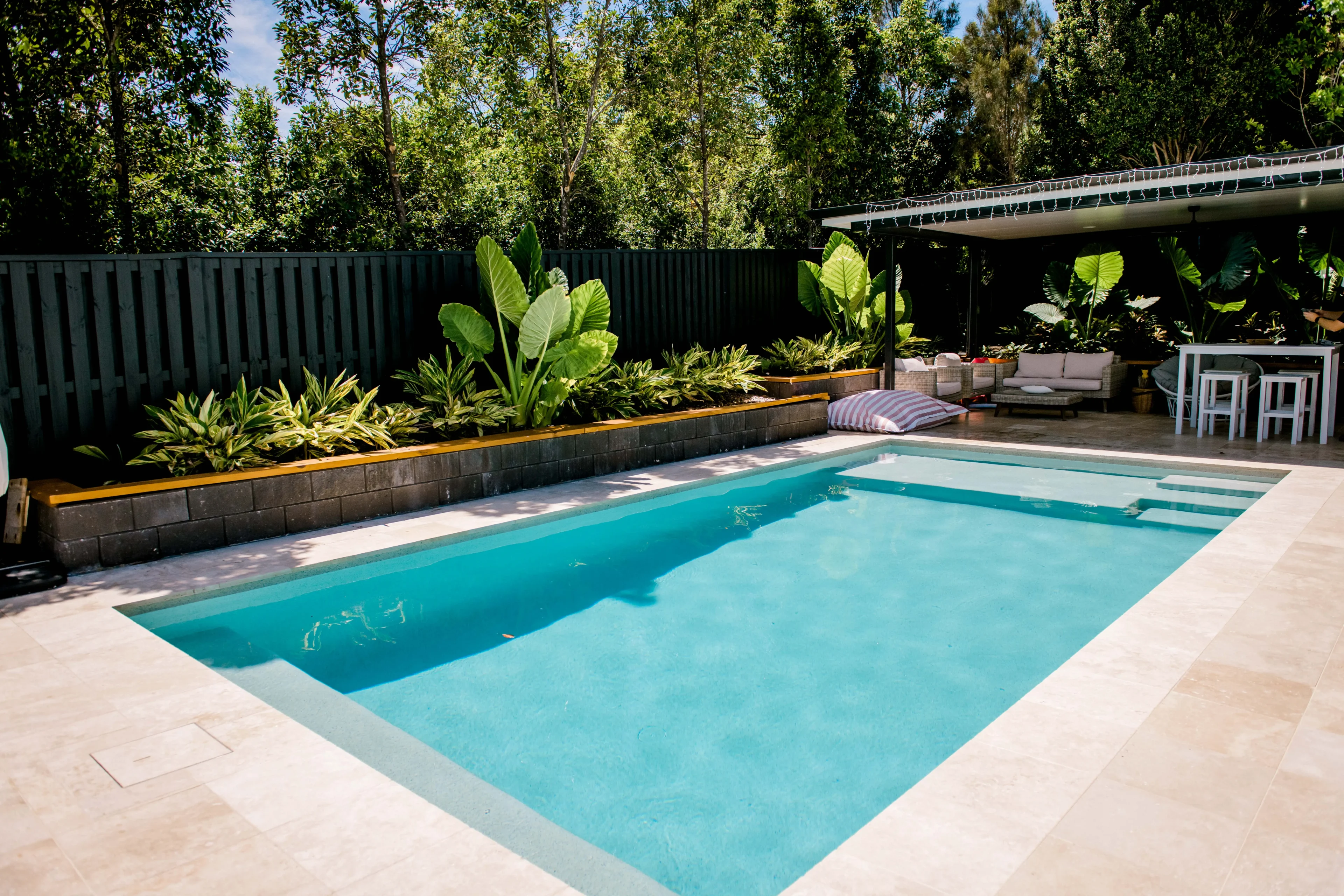
If you’ve started planning your new pool, you’ve likely hit the same question every homeowner faces: concrete or fibreglass?
It’s a choice that can shape not only how your pool looks, but how it feels, functions, and lasts over time.
Both pool types have earned their place in Australian backyards. Fibreglass pools are known for their convenience and classic look, while concrete pools offer way more design freedom and a custom fit for any space.
In this guide, we break down the real differences between concrete vs fibreglass pools, from cost and installation to design and durability.
We’ll show you exactly which pool type is the right fit for your home, your space, and the way you live.
Before diving into the finer details, here’s how concrete and fibreglass pools stack up side by side. This quick comparison highlights the main differences in design, cost, installation, and longevity, giving you a clear picture of what each pool type offers.
Feature | Concrete Pool | Fibreglass Pool |
Design Flexibility | Fully custom-built to suit any shape, size, or layout | Limited to pre-made moulds and sizes |
Aesthetic Options | Endless finishes and colours, including modern lighter tones | Restricted range of darker shell colours |
Installation Time | 8–12 weeks (varies by design and site) | 1–3 weeks (prefabricated shell) |
Durability | Extremely strong and long-lasting (30+ years) | Slightly shorter lifespan (typically 15–20 years) |
Maintenance | Moderate — occasional cleaning and resurfacing | Low short-term upkeep, but harder to repair if anything goes wrong |
Cost | Higher upfront, greater value at resale | Lower upfront, may cost more over time |
When you compare them side by side, both pool types deliver value in different ways.
Concrete pools are built completely from scratch, giving you full control over the design, shape, and layout.
They’re formed on-site using a steel-reinforced framework that’s sprayed or poured with concrete, then finished with materials like tiles, pebblecrete, or rendered surfaces.
Because they’re custom-built, concrete pools can be designed to follow the flow of your property, from small plunge pools to large family designs or feature pools with infinity edges and integrated spas.
They’re also adaptable to almost any site, including sloping or uneven blocks where pre-made pool shells wouldn’t fit.
The result is a durable, long-lasting pool that becomes part of your home’s architecture. With the right care, a concrete pool can last for decades while keeping its structure, style, and value intact.
Fibreglass pools are prefabricated shells manufactured in a factory and then transported to your property for installation. Each shell is made from a mould, which means the shape, size, and depth are fixed.
Once delivered, the shell is placed into an excavated hole, levelled, and plumbed, making installation quicker than a custom concrete build.
These pools come with a smooth, gel-coated interior that resists algae growth and offers a sleek finish. However, colour and finish options are limited to the manufacturer’s range, and lighter tones are less common.
Fibreglass pools suit homes with straightforward layouts and easy site access, particularly if a fast turnaround is important. While the shell can last many years, it can be harder to repair or replace if surface damage, fading, or warping occurs over time.
Every pool type comes with strengths and trade-offs. Understanding these helps you see how each performs in real-world conditions, from the build process to long-term upkeep.
When you weigh them up, fibreglass pools can offer convenience and speed, while concrete pools provide creative control, longevity, and a more seamless fit for your property.
When comparing concrete and fibreglass pools, cost is often the deciding factor. While the upfront figures might look simple, the total expense depends on what’s included in the build, what needs to be added later, and how your site and design choices affect installation.
While fibreglass appears cheaper at first glance, these prices usually cover basic installation only. Extra features, site preparation, or access equipment can quickly narrow the price gap.
Even with standard pricing, both pool types can attract add-ons that change the final figure:
Concrete pools offer full creative control, from pebblecrete and tiles to custom colours and waterline features, all of which influence price.
Fibreglass pools come in fixed finishes and colours. While this keeps costs predictable, it limits design choice and may not suit every home’s style.
If you prefer lighter, modern finishes or want a pool that blends seamlessly with your landscape, concrete provides more options, even if it comes with a higher initial investment.
It’s worth considering how each pool’s value changes over time:
Across their lifespans, both pool types can deliver value in different ways, whether through lower initial costs or longer-term durability.
Every homeowner has different goals when planning a pool. Some want a quick, cost-effective installation. Others want a custom feature that enhances their home’s design and value.
Here’s exactly how to decide which option best fits your situation.
Concrete pools suit homeowners who want a purposeful, design-driven feature that feels like part of their home, not an addition to it.
Fibreglass pools suit homeowners who want simplicity, speed, and a set design that delivers quick results with minimal construction.
Some homes are suited to both pool types. In these cases, your priorities will help you decide:
Both pool types can deliver great results when chosen for the right reasons.
If you want a pool that feels personal, is designed for your home, and is built to last, concrete pools are easily the best option and offer the greatest potential.
If you prefer a faster installation and a fixed design, fibreglass can deliver a solid result with less complexity.
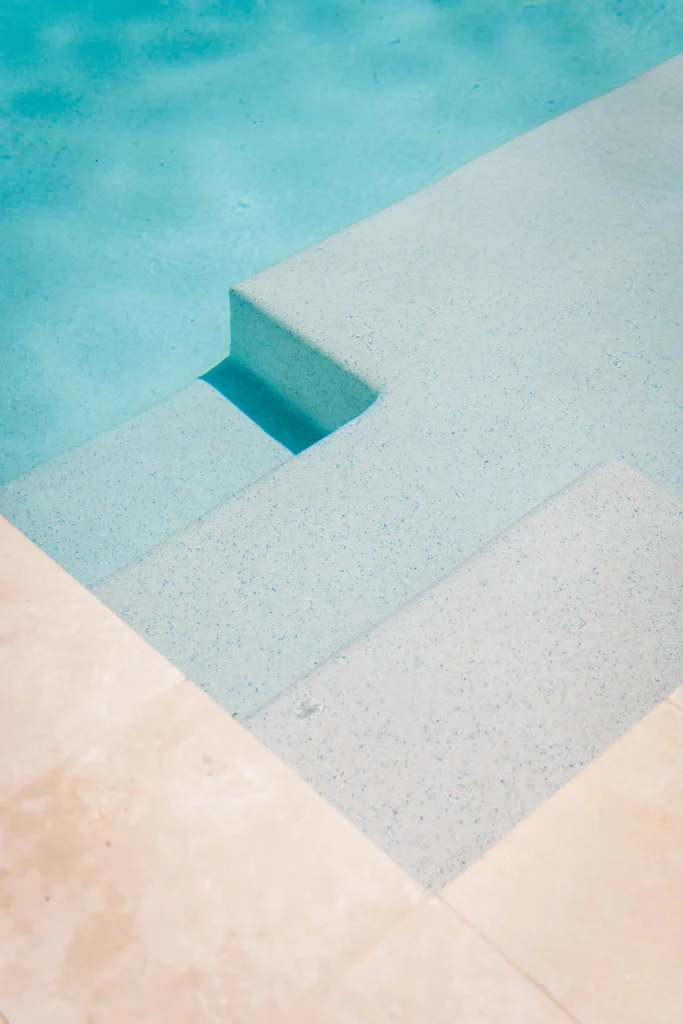
There’s plenty of mixed information online about concrete and fibreglass pools. Some of it’s outdated, and some is simply wrong.
Before you decide which pool type to get, you should debunk some of the common myths flying around:
Modern concrete pools are engineered with reinforced steel and advanced construction techniques that significantly reduce cracking. Hairline surface marks can appear over time but are typically cosmetic and easy to repair. With proper construction and maintenance, a concrete pool can stay structurally sound for decades.
While fibreglass pools are low-maintenance, they’re not maintenance-free. Water chemistry still needs to be balanced, and the gel coat surface can fade or blister with exposure and age. Maintenance is simply different, not nonexistent.
Concrete pools do cost more upfront, but the difference often isn’t as large as people expect once site preparation, crane hire, and landscaping for fibreglass are included. Over time, a concrete pool’s lifespan and resale value often balance the investment.
Fibreglass shells have a smooth finish, but they can become slippery, especially when wet. Concrete finishes can be textured or sealed for better grip, making them equally safe and comfortable underfoot.
Each pool type has evolved over the years, and the technology behind both is far more advanced than it once was. The key difference now comes down to customisation, longevity, and design flexibility.
Now that you understand the real differences between concrete and fibreglass pools, you can see why more Australian homeowners are choosing concrete for long-term value, design freedom, and a seamless fit with their property.
At Aqua Living Pools, we specialise in building custom concrete pools that are designed around your lifestyle and your home, not a template.
Every project is built to last, combining architectural design with precision construction to create a pool that feels like it’s always been part of your space.
Whether you’re after a modern plunge pool, a statement family pool, or something unique, we can help you bring it to life.
Contact our experienced team online today or call 1300 931 300 and discover how we can turn your vision into a space built for living.
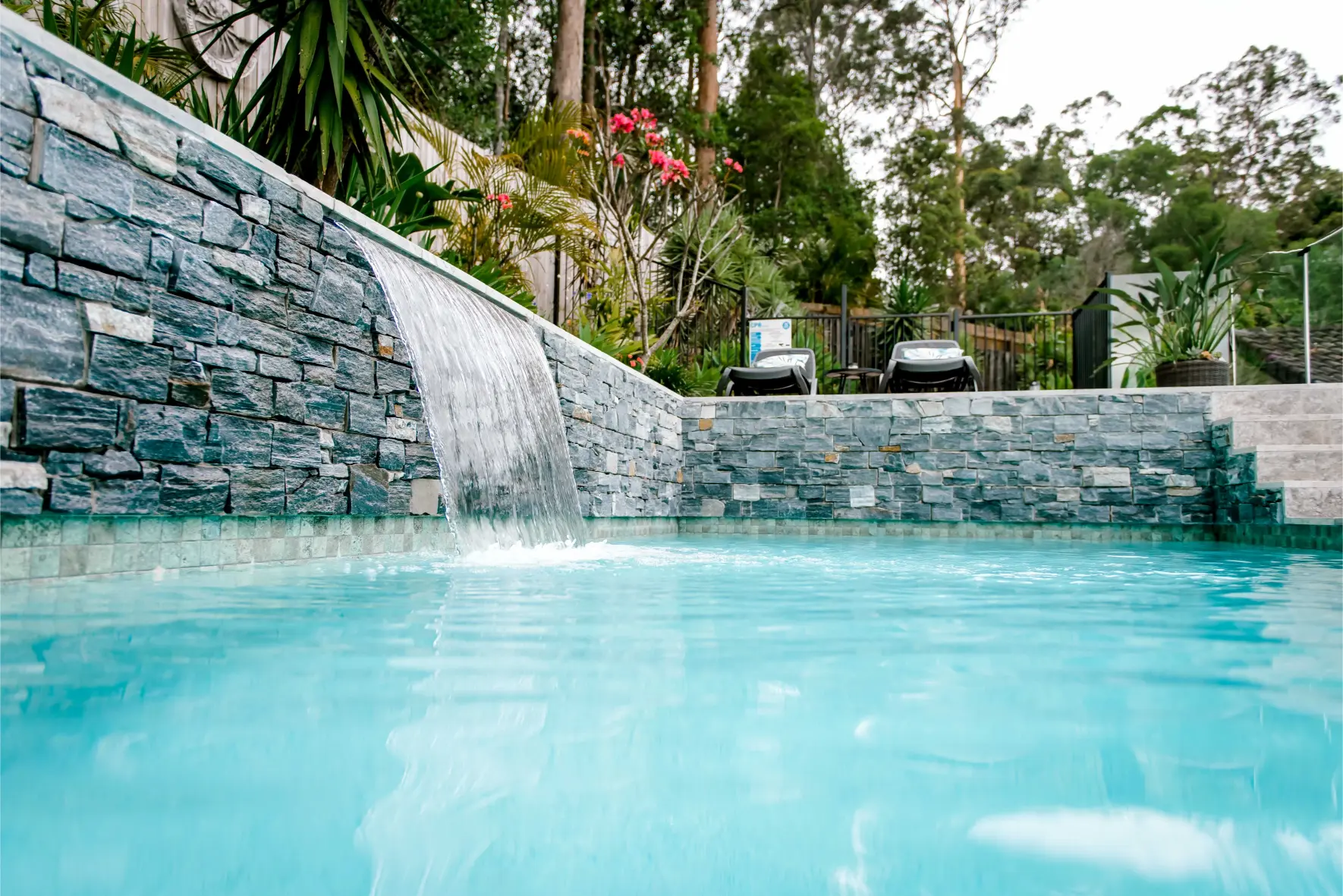
Feel like your backyard’s going to waste? Or perhaps you want to install a pool but don’t have a lot of room to work with?
A plunge pool could turn that unused space into the best part of your home, a place to cool off, relax, and add long-term value.
More affordable than full-size pools and perfect for smaller blocks, plunge pools are quickly becoming the go-to choice for Aussie homeowners.
If you’re wondering, “How much does a plunge pool cost?” Here’s what you need to know and how to get it right from the start.
If you’re planning a plunge pool project, the cost is likely one of your first questions.
While prices can vary depending on design, site access, and inclusions, our standard-sized concrete plunge pools typically start at $45,000 for a 6x4m pool with a deep point of 1.8m on a flat, accessible block.
This base price covers:
However, this is just the starting point.
It’s rare for us to build a pool without additional features or site-specific adjustments.
We’ve built pools for as much as $200,000 due to a client’s specific needs and property layout.
It’s important to read the rest of this article so you understand the factors that will determine the cost of your pool based on your unique needs and site conditions.
Understanding the variables will help you plan your budget more effectively. We hope this guide helps you identify key cost factors when finalising your plunge pool design.
Remember, the figures below are price ranges based on our personal experience working with clients. Your individual needs or site conditions may result in higher or lower costs, depending on excavation challenges, material choices, or additional features.
Even with plunge pools, size and shape still play a major role in the total cost.
While many plunge pools start at around a 6×4 metre pool with a deep point of 1.8 metres, increasing the size or opting for a more complex design will raise material, labour, and engineering expenses.
Extending your plunge pool’s length or width means more excavation, concrete, and steel, which all add up.
As a rough guide, you can expect to pay around $3,500 for every additional metre in length.
It’s also worth noting that once your pool reaches certain dimensions, steel reinforcement requirements can double, which can cause a sharp increase in cost.
Because this depends on site-specific factors, it’s best to discuss this directly with your local pool builder.
Keeping the shape simple, like a straight rectangle, is the most cost-effective option.
Design elements such as built-in bench seats, curved walls, spa zones, or infinity edges require more time, specialised formwork, and custom engineering.
These types of pool features can add anywhere from $3,000 to $25,000 to your overall build cost.
Site conditions are one of the most important cost factors when planning a plunge pool.
While a flat, accessible block keeps pricing down, more challenging sites can quickly increase excavation, engineering, and labour costs.
In most cases, this adds between $3,000 and $10,000+ to your overall budget.
Here are the most common site challenges and how they affect pricing:
If your property has limited access, narrow side gates, steep driveways, or obstacles like trees or retaining walls, your builder may need to use smaller machinery or carry out manual labour.
This increases time and cost, sometimes adding $5,000 or more to the project.
In some cases, shifting the plunge pool to a front yard location can reduce costs caused by tight access.
On sloped sites, builders must level the area before construction begins. This can involve:
Our team is highly experienced in building pools on sloping blocks and can help provide practical advice on how to best work with your site’s natural gradient.
Not all soil is created equal. Problematic ground can drive up costs:
If private sewer or stormwater pipes are in the way, they may need to be relocated. This typically costs $1,000 to $2,000, depending on the layout.
Note: We can redirect private pipework (stormwater and sewer), but city council lines or inspection points cannot be diverted. There is a minimum required setback, which must be considered in your pool design.
If any demolition is needed, such as removing concrete, decking, or old structures, expect an additional $1,000 to $5,000+ to the total spend, based on the size and materials.
Once the shell is sorted, it’s the finishes that really bring your plunge pool to life.
These choices aren’t just about looks; they’ll impact how your pool feels to swim in, how easy it is to maintain, and how well it fits into your backyard.
Depending on your choices, the finishes can add anywhere from $4,500 to over $50,000 to your total pool cost.
Here’s how we guide our clients through these decisions, and what you might expect.
The interior finish affects both the visual effect and how your pool feels underfoot.
While concrete plunge pools allow for greater flexibility than fibreglass, the cost will vary based on the material you choose.
Below, we break down the key costs and considerations for each:
Pebblecrete has come a long way—no more sore feet after a swim! Modern pebble finishes provide a smooth yet durable surface, making them a great choice for any concrete pool.
At Aqua Living Pools, we offer two types of Pebblecrete finishes:
Not all soil is the same, and difficult ground conditions can require extra work:
In some cases, private stormwater or sewer pipes may need to be redirected, adding $1,000 to $2,000, depending on the complexity and distance of the pipework.
Note: We can redirect private pipework (stormwater and sewer), but city council lines or inspection points cannot be diverted. There is a minimum required setback, which must be considered in your pool design.
If demolition or removal of concrete, old paving, or existing structures is required, additional costs can range from $1,000 to $5,000+, depending on the scope of work.
Beyond the pool itself, the interior finish, surrounding landscape, and fencing all play a crucial role in the overall look, functionality, and compliance of your concrete pool.
These elements can add anywhere from $4,500 to $50,000+, depending on the materials, design complexity, and council regulations.
Choosing the right interior finish affects durability and maintenance, while landscaping and fencing ensure your pool integrates seamlessly into your outdoor space while meeting safety requirements.
Below, we break down the key costs and considerations for each:
Pebblecrete:
Pebblecrete has come a long way—no more sore feet after a swim! Modern pebble finishes provide a smooth yet durable surface, making them a great choice for any concrete pool.
At Aqua Living Pools, we offer two types of Pebblecrete finishes:
While New Zealand White Pebblecrete is included in our base price, if you’re comparing quotes, be sure to ask your local pool builder what their standard interior finish includes.
A premium finish where the entire pool is lined with ceramic, porcelain, or glass tiles creates a smooth, high-end look.
It’s long-lasting, non-porous, and reduces algae buildup, making maintenance easier.
However, it comes at a higher upfront cost and requires more labour for installation. Pricing is around $22,000 extra for this finish for a 6m x 4m pool from 1.2-1.8m deep.
Pool heating is something more and more of our clients are adding, especially if you want to get more use out of the pool during cooler months. For a 6x4m plunge pool, heating starts at around $4,500.
Here’s a quick overview of the most common options:
If you’re unsure which is best, we’ll talk you through what suits your usage, site and power setup.
Pool fencing is a legal requirement in Australia and plays a key role in safety and aesthetics.
The cost depends on the material chosen, with frameless glass providing a sleek, modern look, while aluminium options offer a more budget-friendly alternative. You can choose between:
If you’re looking to achieve a high-end finish while managing costs, we recommend using glass for key areas and aluminium for less visible sections.
We always recommend tiling 2 or 3 rows beyond the edge of your plunge pool.
It gives you a safe, slip-resistant space to walk around the pool, and visually ties everything together.
Extended tiling is calculated at $645 per m², which includes a concrete slab and a tile allowance of $85 per m².
We also have clients who choose to create a tiled pad at one end of the pool for lounge chairs or umbrellas.
We don’t do landscaping in-house, but we work with a great network of local landscapers we’re happy to refer you to.
That includes turfing, garden beds, decking, and anything else you want to complete your backyard.
If you’re planning a big transformation, we can help you coordinate timing so everything flows smoothly from the pool build to the final landscaping.
As you’ve probably realised reading this article, if you’re looking into building a pool, it’s probably easier if you call your local pool builder so they can give you more personalised advice.
If you live on the Gold Coast or in Brisbane, we’re award-winning pool builders who pride ourselves on delivering the highest quality pool designs and construction.
We can help you customise your plunge pool to suit your space, lifestyle, and budget, ensuring a seamless design and build process.
Fill out our online form, and a member of our team will be in touch to discuss your vision.
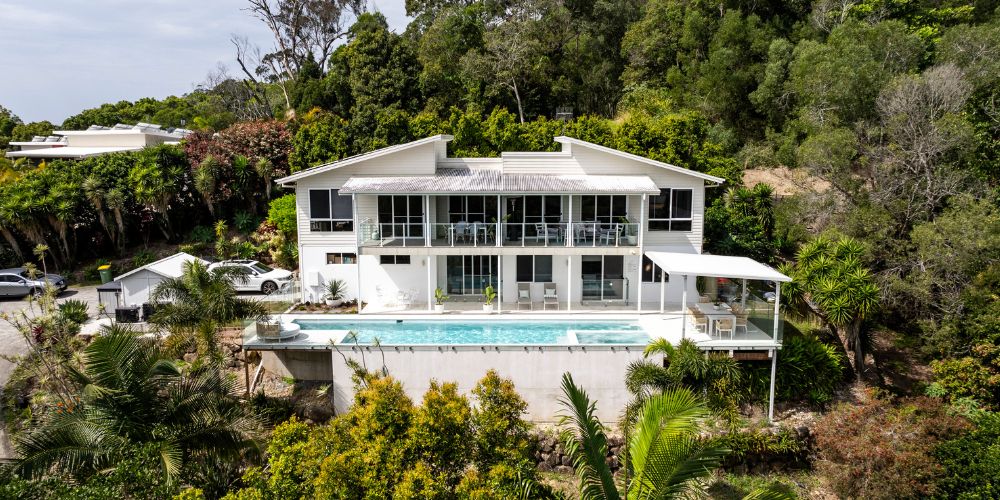
Building a pool on a sloping block presents extra challenges but also offers unique advantages. While uneven ground can add complexity to construction, it also presents opportunities for standout designs, elevated views, and innovative landscaping.
This guide breaks down what you need to know before building a pool on a sloping block. We’ll cover the most common challenges, popular design options, structural requirements and smart ways to manage costs.
Whether you’re dealing with a slight incline or a steep drop, there are reliable solutions available.
The slope of your land directly impacts how your pool is built, what structural elements are required, and how the space around it functions.
Out-of-ground pools require formwork, where a timber frame is built to shape and support the concrete while it sets. These builds may also need deep piers to stabilise the structure, especially where soil conditions vary. Both elements add cost and time to the project, but they’re essential for long-term strength.
On steeper blocks, the pool shell may need to be built partially or fully above ground. While this adds extra construction steps, it also opens up unique design possibilities.
Elevated pools can offer better views, integrate seamlessly with multi-level landscaping, and enable features like infinity edges that wouldn’t be possible on flat ground. With smart planning, a sloping block can become a strength, not a setback.
Challenge | What It Means |
Excavation and levelling | Sloping ground often needs to be cut, filled, or stabilised to create a level base for the pool. This can add to the overall time and cost of construction. Plus, on steeper blocks, full in-ground installation may not be practical. |
Drainage and soil movement | Proper drainage design is essential to direct water away from the pool structure. Without it, water pressure can build up behind retaining walls, leading to soil erosion and long-term structural issues. |
Geotechnical reporting | A geotechnical report may be required to assess soil conditions and slope stability. This ensures the pool is engineered to suit the block’s specific characteristics and helps prevent unexpected issues during construction. |
Structural support | Steeper blocks often require deep piers to anchor the pool structure. These provide stability and prevent movement or cracking, especially on reactive or shifting soils. |
Equipment placement | Pool equipment must be located away from exposed pool walls and splash zones. This protects electrical components from water damage and ensures safe, long-term performance. |
Sloping blocks can open the door to creative and functional pool designs. The right approach depends on the degree of slope, your budget, and how you want to use the surrounding space.
A swimming pool retaining wall is one of the most common solutions for sloping sites. It helps create a level platform by holding back the surrounding soil. These walls can be visible or integrated into the landscape as garden beds, seating, or feature walls.
This option suits blocks with moderate slopes and gives you flexibility in how the surrounding area is finished. Retaining walls are also essential for managing drainage and protecting the structure over time.
Infinity edge pools work well on steep, downward-facing blocks. One side of the pool has a lowered edge, allowing water to flow over into a reservoir and recirculate back into the main pool.
This style makes the most of elevated views and delivers a seamless, high-end finish. It’s ideal for properties overlooking bushland, the ocean, or open landscapes. While more expensive, the visual impact results in a show-stopping pool design.
If your yard is divided into levels or has an existing drop, a split-level pool design can work with the landscape instead of against it. This style creates zones across multiple heights, such as a swim area on one level and a lounge or deck space on another.
The key is to focus your budget on structural integrity and functionality first, and add any extras in later.
A classic, rectangular shape or plunge pool will keep construction straightforward, and positioning the pool closer to the house can reduce excavation and access costs.
Including premium features like glass windows or full-length infinity edges looks impressive, but comes at a high cost.
If your budget is limited, finishes like extended tiling and basic landscaping can really finish the look without overspending.
Water features, such as fountains or waterfalls, can always be added down the track once the core build is complete, allowing you to upgrade the space when your budget allows.
Designing a pool on a sloping block isn’t just about structure and style. It’s also about ensuring the finished space is safe, stable, and manageable in the long term.
Elevation changes often require built-in steps, ledges, or platforms to allow for safe movement around the pool. These should be clearly defined and supported by solid handrails if needed.
Fencing requirements are also dependent on the pool’s elevation. If a pool wall sits more than 1.2 metres above ground and is non-climbable, no fence is required, allowing for unimpeded views. However, fencing is required again once the wall exceeds 2 metres in height. Learn more about Queensland’s pool fencing rules in these QBCC Guidelines.
The landscaping around your pool does more than add visual appeal; it plays a key role in stabilising the slope. Using retaining walls, ground covers, and native plants helps hold soil in place, manage water flow, and prevent erosion over time. Integrated landscaping also reduces run-off and protects the pool structure.
A smart design can make your pool easier to maintain from day one. Ensure drainage systems are installed and functioning well, particularly behind retaining walls. Keep equipment areas accessible and away from zones prone to water splash or debris. Choosing low-maintenance materials and simple landscaping layouts also reduces ongoing upkeep.
When building a pool on a sloping block, it’s essential to work with a team that understands the specific challenges of uneven sites and knows how to maximise the opportunities they present.
At Aqua Living Pools, we are highly experienced in complex build sites, so we can take on sloping block projects that many other builders won’t touch. We’ll handle everything from structural design advice to sourcing required geotechnical reports to make the process easier for you.
Call our Gold Coast pool builders today on 1300 931 300 to build with confidence, no matter how steep or challenging your block may be.
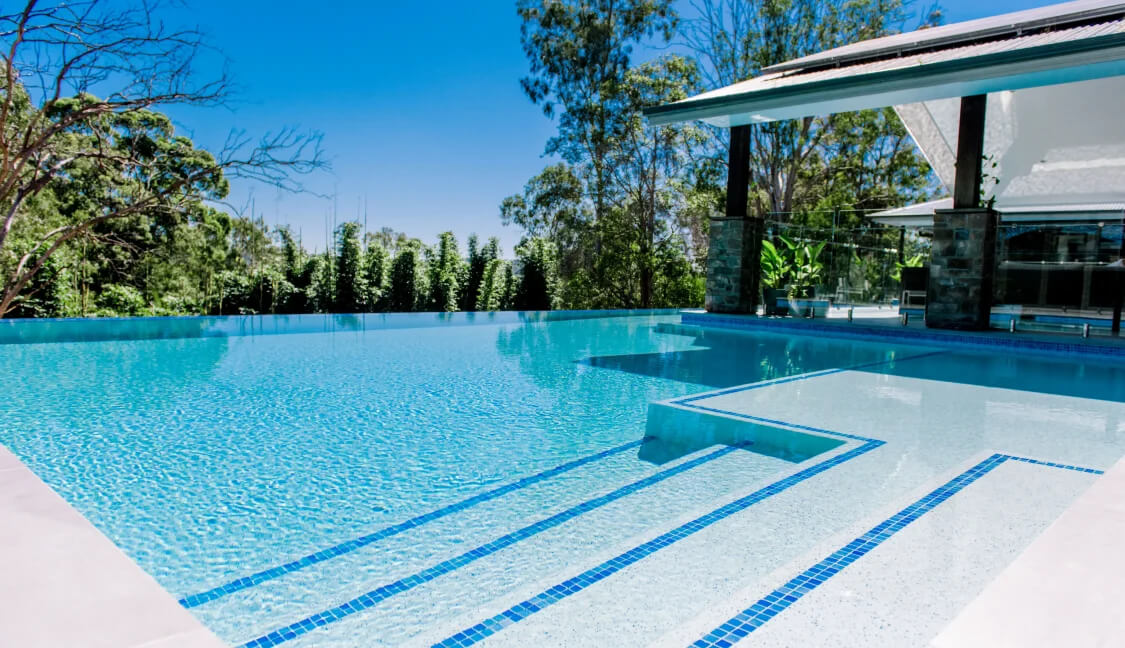
The cost of a pool on the Gold Coast depends on several factors, but as a starting point, our standard-sized pools typically begin at $45,000 with a 6-metre by 4-metre or 7-metre by 3-metre pool with a depth of 1.8 metres. This base price covers:
However, this is just the starting point.
It’s rare for us to build a pool without additional features or site-specific adjustments.
It’s important to read the rest of this article, so you understand the factors that will determine the cost of your pool based on your unique needs and site conditions.
Different pool designs come with different construction requirements, meaning starting prices vary. Below is a general guide to starting costs based on pool type. These figures are indicative only and will depend on your site, access, and design preferences.
These figures cover base inclusions only. Keep reading to see what factors you might need to consider based on your needs and property type.
Understanding the variables will help you plan your budget more effectively. We hope this guide helps you identify key cost factors when finalising your pool design.
Remember, the figures below are price ranges based on our personal experience working with clients. Your individual needs or site conditions may result in higher or lower costs, depending on excavation challenges, material choices, or additional features.
The dimensions and shape of your pool will significantly impact the total cost.
As we mentioned in the introduction, a standard 10-metre by 3-metre concrete pool typically starts at $55,000, but as size and design complexity increase, so do material, labour, and engineering costs.
Adding more length and width to your pool requires additional excavation, reinforcement and materials.
Something to keep in mind however is that once a pool reaches a certain length, the required steel reinforcement doubles. This will dramatically increase the price. It’s difficult to explain when this occurs in a blog post so we recommend you discuss this directly with your local pool builder.
A straight rectangular design is the most cost-efficient and structurally simple option.
Adding additional design features such as built-in ledges, seating areas, rounded edges, infinity edges, or curved walls requires more labour, custom formwork, and engineering.
The condition of your site is one of the biggest factors affecting the total cost of a pool.
While a flat, easily accessible block keeps costs lower, more complex sites can require additional excavation, engineering, and labour.
Here are the most common site challenges we encounter and how they can impact your total pool cost:
If your property has limited access—such as narrow side passages, steep driveways, or obstacles like trees and retaining walls—your pool builder may need to use a mini excavator instead of standard machinery, increasing labour costs.
If you anticipate accessibility challenges, relocating the pool to your front yard could be a cost-saving alternative.
If your property has a slope, excavation must compensate for the height difference. This can involve:
In some cases, private stormwater or sewer pipes may need to be redirected, depending on the complexity and distance of the pipework.
Note: We can redirect private pipework (stormwater and sewer), but city council lines or inspection points cannot be diverted. There is a minimum required setback, which must be considered in your pool design.
If demolition or removal of concrete, old paving, or existing structures is required.
Beyond the pool itself, the interior finish, surrounding landscape, and fencing all play a crucial role in the overall look, functionality, and compliance of your concrete pool.
Choosing the right interior finish affects durability and maintenance, while landscaping and fencing ensure your pool integrates seamlessly into your outdoor space while meeting safety requirements.
Below, we break down the key costs and considerations for each:
Pebblecrete:
Pebblecrete has come a long way—no more sore feet after a swim! Modern pebble finishes provide a smooth yet durable surface, making them a great choice for any concrete pool.
At Aqua Living Pools, we offer two types of Pebblecrete finishes:
While New Zealand White Pebblecrete is included in our base price, if you’re comparing quotes, be sure to ask your local pool builder what their standard interior finish includes.
Tiled Interior:
A premium finish where the entire pool is lined with ceramic, porcelain, or glass tiles, creates a smooth, high-end look. It’s long-lasting, non-porous, and reduces algae buildup, making maintenance easier. However, it comes at a higher upfront cost and requires more labour for installation. Pricing is around $22,000 extra for this finish for a 10m x 3m x 1.5m pool.
Choosing the right heating system depends on your budget, climate, and how often you plan to use your pool.
Heating starts at $4,500 for a 6x4m pool and you can choose between the following options:
Pool fencing is a legal requirement in Australia and plays a key role in safety and aesthetics.
The cost depends on the material chosen, with frameless glass providing a sleek, modern look, while aluminium options offer a more budget-friendly alternative. You can choose between:
If you’re looking to achieve a high-end finish while managing costs we recommend using glass for key areas and aluminium for less visible sections.
Extending the tiling beyond the pool’s edge enhances both functionality and aesthetics, creating a seamless transition between the pool and the surrounding area.
Most homeowners choose to install 2–3 rows of tiles around the pool, providing comfortable walking space and ensuring ease of movement along the water’s edge.
For added functionality, many clients opt for a paved pad at one end of the pool, creating a dedicated space for umbrellas, lounge chairs, or seating areas.
We don’t offer landscaping services for things such as grass, plant and decking installation, so we’re unable to provide specific cost estimates.
When we work with clients who are looking for additional landscaping, we have a range of trusted landscapers who we have worked alongside in the past and who we are happy to refer you to.
As you’ve probably realised reading this article, if you’re looking into building a pool, it’s probably easier if you call your local pool builder so they can give you more personalised advice,
If you live on the Gold Coast, we’re award-winning pool builders who pride ourselves on delivering the highest quality pool designs and construction.
We can help you customise your pool to suit your space, lifestyle, and budget, ensuring a seamless design and build process.
Fill out our online form and a member of our team will be in touch to discuss your vision.
When it comes to enjoying your swimming pool, the temperature of the water plays a significant role in how often and comfortably you can swim. While natural weather conditions are great for those warm summer days, cooler temperatures can limit your swimming time. That’s where an electric heater comes in! Installing an electric heater in your concrete swimming pool offers a range of benefits that can enhance your swimming experience and extend the life of your pool.
One of the biggest advantages of adding an electric heater to your pool is the ability to extend your swimming season. Without a heater, most pools are limited to warm weather months, and as the weather cools, your pool becomes too cold to enjoy. An electric pool heater gives you full control over the water temperature, meaning you can swim comfortably even during cooler spring or autumn days.
Benefit: Swim during cooler months, making the most of your investment.
Electric heaters provide precise control over your pool’s temperature. Unlike solar or gas heaters, which may be more affected by weather conditions (such as cloudy skies or wind), electric heaters maintain a consistent temperature. This means you can set your pool to the exact warmth you desire, ensuring optimal comfort whenever you take a dip.
Benefit: Consistent and customisable water temperatures, perfect for comfort.
While gas heaters are powerful, they can be costly to operate due to high energy consumption. On the other hand, electric heaters are generally more energy-efficient, especially when you only need to heat the pool to a modest temperature. They use electricity to power a heating element that raises the water temperature, and many models feature thermostats to prevent overheating, which helps save energy. With an electric heater, you have more control over energy use, and with proper management, it can be a more cost-effective solution in the long run.
Benefit: Energy-efficient and cost-effective compared to other heating options.
Electric heaters tend to be low-maintenance and have a long lifespan when properly cared for. Unlike gas heaters, which may require frequent servicing or replacement of parts such as burners or heat exchangers, electric heaters have fewer components that are prone to wear and tear. This makes them a hassle-free option for homeowners who want to enjoy their pool without worrying about constant repairs or maintenance.
Benefit: Fewer maintenance requirements and long-lasting performance.
For smaller concrete pools, electric heaters are an ideal choice. They are particularly effective in heating smaller volumes of water quickly and efficiently. Since smaller pools generally don’t require as much energy to heat, an electric heater can be an affordable and practical solution without the need for more expensive or bulky heating systems.
Benefit: Ideal for smaller pools, offering fast and efficient heating.
Electric pool heaters operate much quieter than gas heaters, which can sometimes produce a lot of noise while heating. This makes electric heaters ideal for pools located near outdoor living spaces or areas where noise could be disruptive. If you value peace and quiet in your backyard, an electric heater is an excellent choice for maintaining a serene environment.
Benefit: Quiet operation for a peaceful and relaxing pool experience.
Installing an electric heater is faster and simpler than installing a gas or solar heater. Electric can be easily connected to your filtration pool system. This means less disruption to your backyard and less time spent waiting for your heater to be ready for use.
Benefit: Faster and less complicated installation compared to other heating systems.
When combined with a pool cover, an electric heater can significantly reduce the amount of energy required to maintain your pool’s temperature. A cover helps retain heat and prevents heat loss, allowing the electric heater to maintain a comfortable temperature with less energy use. This combination makes for an incredibly efficient heating solution.
Benefit: Maximise energy savings by pairing with a pool cover.
Including an electric heater to your concrete pool can also increase the overall value of your property. Prospective homebuyers appreciate the luxury of being able to enjoy a heated pool and an energy-efficient electric heater can be an attractive selling point. It’s an investment that not only enhances your quality of life now but can also offer long-term financial returns.
Benefit: Adds value to your home, especially if you’re considering selling in the future.